
Samrt Band for Dementia
A wearable device designed to improve safety and enable location tracking for people with dementia.

Quasar Variability Analysis
16 years of data from SDSS and Pan-STARRS to analyse quasar brightness variability — studying 20 of the brightest objects in the universe.

Solar-Powered Water Purifier
A solar-powered, sensor-driven water purifier that autonomously filters and monitors water quality

Protein Milk Bar
A solar-powered, sensor-driven water purifier that autonomously filters and monitors water quality
Smart Band for Dementia


Quasar Variability Analysis
Quasars are the brightest objects in the universe — powered by supermassive black holes — and their brightness changes over time in ways that tell us something important about the physics driving them. I wanted to measure that variability. Not simulate it. Not read about it. Actually measure it using real telescope data.
I combined 16 years of photometric data from two of the world's most powerful sky surveys — SDSS and Pan-STARRS — and built a complete Python data science pipeline from scratch to analyse the brightness variability of the 20 brightest quasars in the SDSS DR9 catalog. Neither survey alone could provide this baseline. Together they gave me a continuous 16-year window into how these objects behave over time.
The analysis showed that roughly 70% of quasars display stochastic low-amplitude variability consistent with a damped random walk — driven by thermal instabilities in the accretion disk. Around 15% showed irregular high-amplitude flares exceeding 0.4 magnitudes. The structure function rose monotonically with time lag across the sample — exactly as accretion disk theory predicts.
The work was produced under the mentorship of a university astronomer through the Collegiate Mentorship Program — written in LaTeX, cited in BibTeX, and submitted as a first-author peer-reviewed paper to international science journals. University-level research. High school age. Real data. Real findings. Real paper.

Solar-Powered Water Purifier
The Solar-Powered Water Purifier is a fully self-sustaining water purification system that runs entirely on solar energy. A 50W solar panel charges a 12V battery through a charge controller, providing a stable power source that works even when the sun isn't shining. A DC water pump pushes raw water through a two-stage filtration system — first a 5-micron sediment filter that removes physical particles, then an activated carbon filter that eliminates chemical contaminants, odour, and organic compounds.
What makes this system intelligent is its sensor layer. A turbidity sensor continuously measures water clarity, and a TDS (Total Dissolved Solids) sensor monitors dissolved chemical content in real time. Both sensors feed live data to an Arduino microcontroller, which makes autonomous decisions — keeping the pump running when water quality is within safe limits, and shutting it off the moment readings exceed predefined thresholds. No human intervention required.
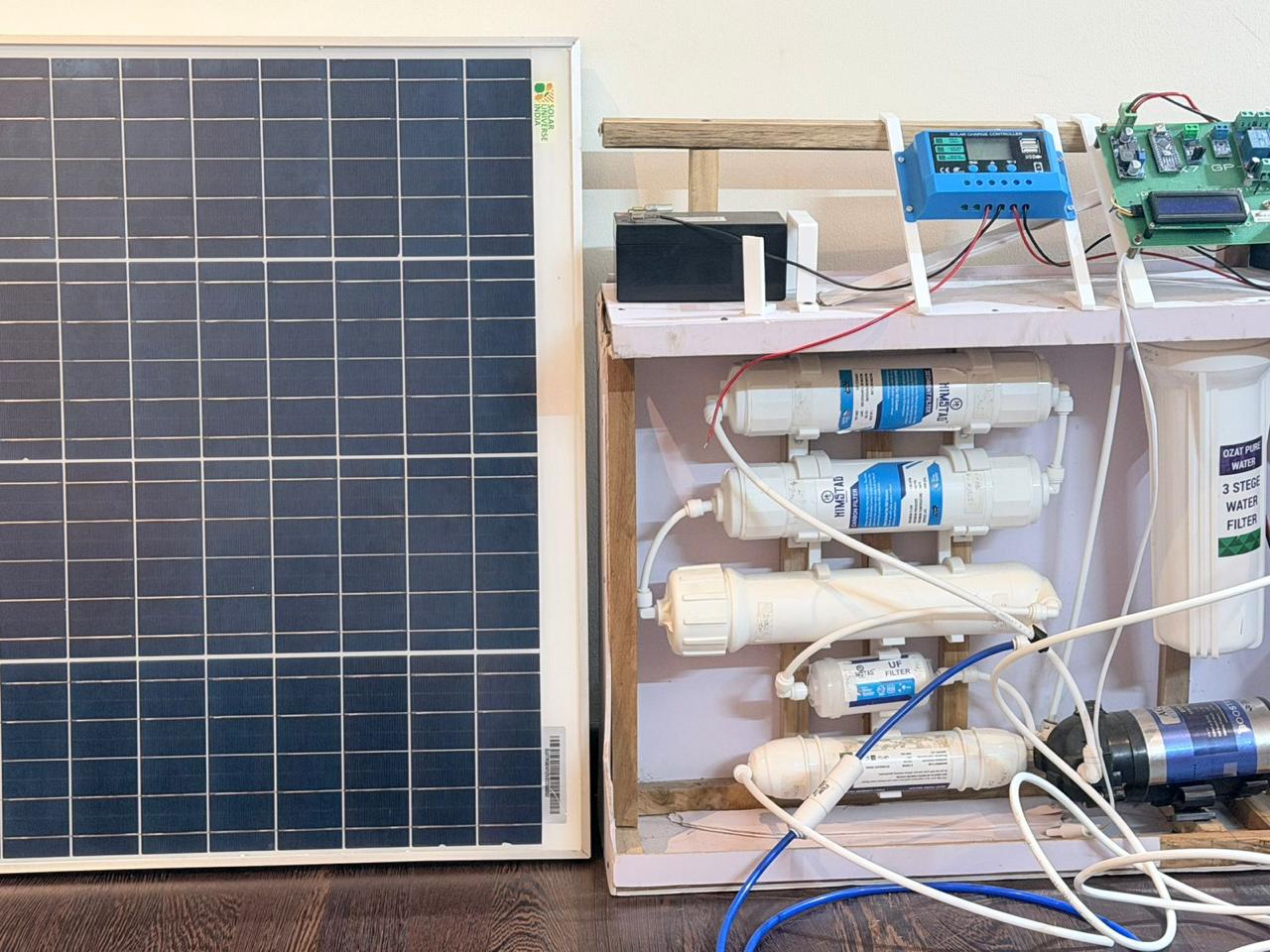
The result is a system that is entirely autonomous, requires no grid power, costs a fraction of commercial purifiers, and can be built and maintained locally. It is designed not as a prototype for a lab — but as a real solution for a real problem, assembled by hand, tested with real water, and built to work in the field.
Protein Milk Bar
Rural school children in Haryana were missing meals before and during school — hurting concentration, attendance, and learning outcomes. Existing midday meal programmes had gaps: no portability, no shelf stability, and low consumption rates. A smarter solution was needed.

Engineered from the ground up for real field conditions — local ingredients, no refrigeration, a 4-month shelf life, and a taste profile children actually enjoy.



Python
NumPy
Astropy
MATLAB
Arduino
Circuit Design
Data Analysis
SolidWorks
3D Printing
Research Writing
Public Speaking
Entrepreneurship