Smart Band for Dementia
Smart Band for Dementia
via Health Monitoring & Geo-Fencing
via Health Monitoring & Geo-Fencing
The problem I kept coming back to was simple but devastating — dementia patients wander. They leave safe environments without awareness, cannot find their way back, and often cannot communicate their situation to the people who find them. The technology to prevent this existed. What did not exist was a device that brought it all together in a form a patient would actually wear.
The problem I kept coming back to was simple but devastating — dementia patients wander. They leave safe environments without awareness, cannot find their way back, and often cannot communicate their situation to the people who find them. The technology to prevent this existed. What did not exist was a device that brought it all together in a form a patient would actually wear.
The problem I kept coming back to was simple but devastating — dementia patients wander. They leave safe environments without awareness, cannot find their way back, and often cannot communicate their situation to the people who find them. The technology to prevent this existed. What did not exist was a device that brought it all together in a form a patient would actually wear.

I designed and built a wearable smart band that combines health monitoring sensors and GPS-based geo-fencing into a single wrist-worn device. The band tracks vital signs continuously and monitors the patient's location in real time. When the patient moves beyond a caregiver-defined safe zone, an immediate alert is triggered — giving caregivers real data and real-time location, not just an alarm after something has already gone wrong.
I designed and built a wearable smart band that combines health monitoring sensors and GPS-based geo-fencing into a single wrist-worn device. The band tracks vital signs continuously and monitors the patient's location in real time. When the patient moves beyond a caregiver-defined safe zone, an immediate alert is triggered — giving caregivers real data and real-time location, not just an alarm after something has already gone wrong.
I designed and built a wearable smart band that combines health monitoring sensors and GPS-based geo-fencing into a single wrist-worn device. The band tracks vital signs continuously and monitors the patient's location in real time. When the patient moves beyond a caregiver-defined safe zone, an immediate alert is triggered — giving caregivers real data and real-time location, not just an alarm after something has already gone wrong.
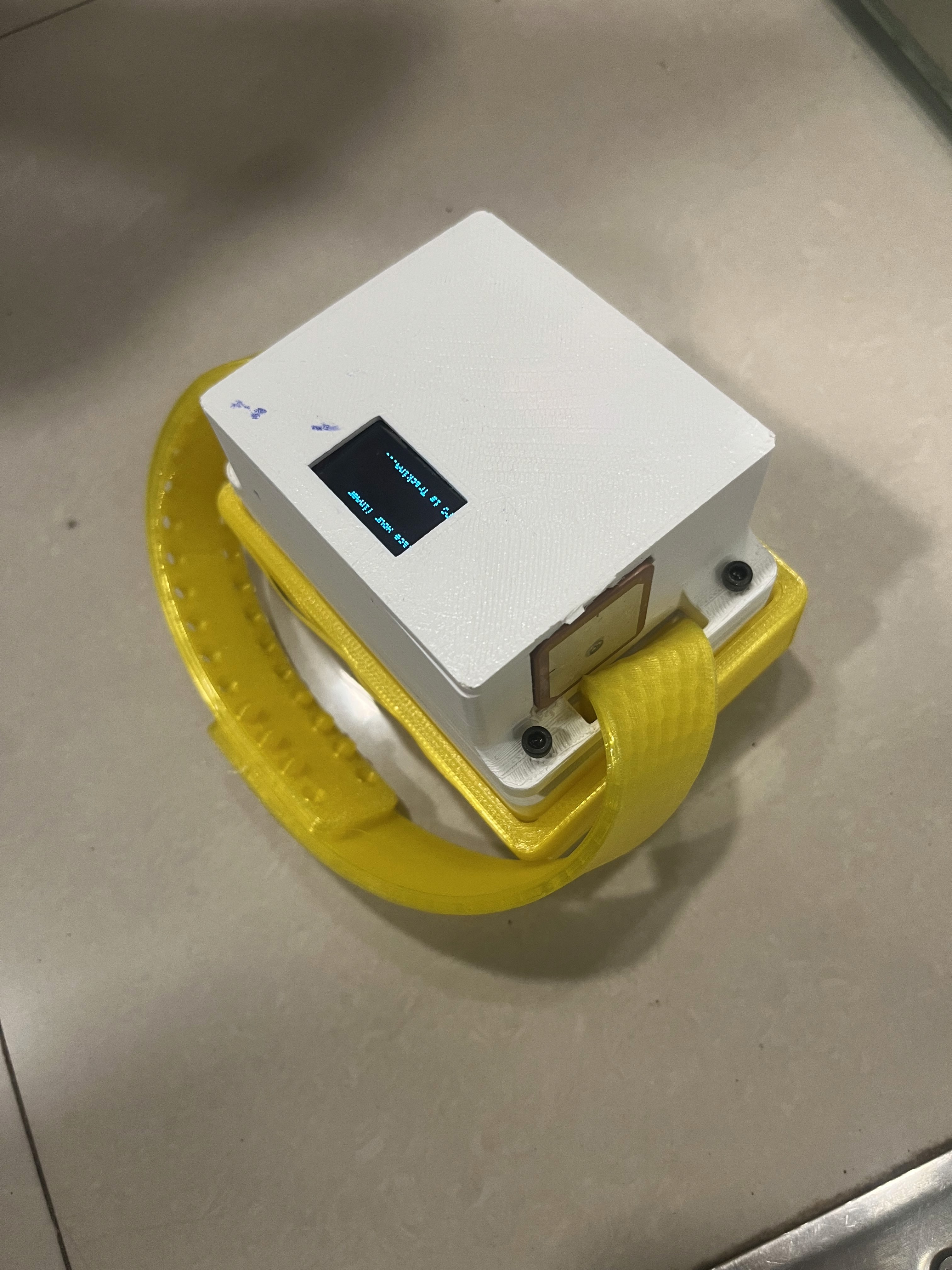


The engineering challenge was not finding the right components. It was assembling them into something a dementia patient would accept on their wrist all day — something that did not feel like a medical device, required zero operation from the patient, and worked reliably in the background without any interaction whatsoever.
The engineering challenge was not finding the right components. It was assembling them into something a dementia patient would accept on their wrist all day — something that did not feel like a medical device, required zero operation from the patient, and worked reliably in the background without any interaction whatsoever.
The engineering challenge was not finding the right components. It was assembling them into something a dementia patient would accept on their wrist all day — something that did not feel like a medical device, required zero operation from the patient, and worked reliably in the background without any interaction whatsoever.
The project was submitted to the CREST Awards programme — run by the British Science Association and supported by UK Research & Innovation. It was reviewed by independent judges and awarded the CREST Gold Award on 18 March 2026 — signed by Dr. Heather King, Vice-President for Education, British Science Association. CREST Gold is the highest level of recognition in the programme. It is not given for trying. It is given for building something that genuinely impresses people who know what they are looking at.
The project was submitted to the CREST Awards programme — run by the British Science Association and supported by UK Research & Innovation. It was reviewed by independent judges and awarded the CREST Gold Award on 18 March 2026 — signed by Dr. Heather King, Vice-President for Education, British Science Association. CREST Gold is the highest level of recognition in the programme. It is not given for trying. It is given for building something that genuinely impresses people who know what they are looking at.
The project was submitted to the CREST Awards programme — run by the British Science Association and supported by UK Research & Innovation. It was reviewed by independent judges and awarded the CREST Gold Award on 18 March 2026 — signed by Dr. Heather King, Vice-President for Education, British Science Association. CREST Gold is the highest level of recognition in the programme. It is not given for trying. It is given for building something that genuinely impresses people who know what they are looking at.

Trusted by many
Skills & Tools
Python
NumPy
Astropy
MATLAB
Arduino
Circuit Design
Data Analysis
SolidWorks
3D Printing
Research Writing
Public Speaking
Entrepreneurship